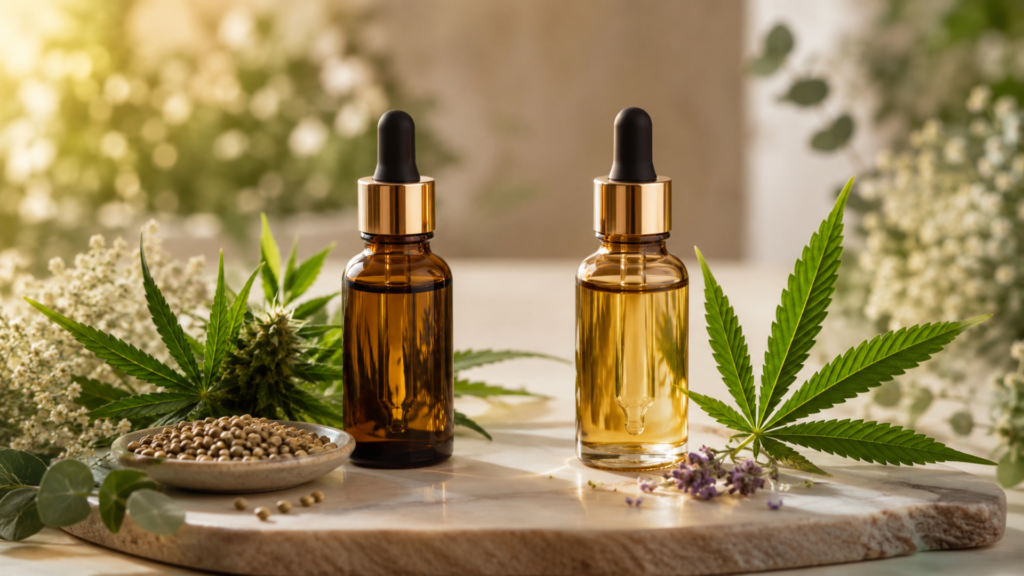
Choosing a quality CBD oil requires looking beyond concentration and marketing claims. The most reliable products provide clear information about extract type, hemp origin, manufacturing, independent laboratory testing, ingredients, and regulatory classification.
Key takeaways:
- Check whether the oil uses Full Spectrum, Broad Spectrum, or CBD isolate, as each has a different composition
- Look for a recent, batch-specific Certificate of Analysis from an independent laboratory
- Confirm where the hemp was grown and whether its cultivation standards are clearly documented
- Review the extraction method and make sure contaminant and residual solvent testing are available
- Check that the CBD percentage, milligram content, and bottle volume match correctly
- Make sure the carrier oil, ingredients, batch number, expiry date, and intended use are clearly stated
- Read the whole lab report, not just the CBD figure: the header, the cannabinoid table, the calculated totals, the safety panels, and whether the report can be verified with the laboratory
Walk into the CBD category for the first time and the immediate problem is not scarcity. It is volume.
The European CBD market has expanded rapidly over the past decade. Grand View Research valued the European cannabidiol market at USD 347.7 million in 2023 and projects growth at a compound annual rate of 25.8 percent through to 2030, reaching around USD 1.7 billion. That growth has produced hundreds of products competing for the same shelf space and the same search results.
From the outside, most of them look interchangeable. Similar bottle, similar dropper, similar percentages on the front, similar language about purity and nature. Underneath, the differences are considerable. Where the hemp was grown, how it was extracted, what else ended up in the bottle, whether anyone independent has verified the contents, and whether the label accurately reflects what is inside are all variables that separate a well-made product from a poorly made one.
Those differences are not visible from the packaging. They have to be looked for.
The purpose of this article is to give you a concrete checklist. Six things worth examining before you buy, what each one actually means, why it matters, and what a good answer looks like. By the end you should be able to evaluate a CBD oil on its own merits rather than taking a brand’s word for it.
One note on framing before we begin. Siam Vital CBD oils are marketed as aromatherapy cosmetic products for external use. This article does not discuss internal use, dosage or health effects, and nothing here should be read as a health claim. It is about product quality: sourcing, manufacturing, testing and transparency.
Why CBD Quality Matters
Before the checklist, it is worth understanding why quality varies as much as it does. The short answer is that CBD sits in an unusually fragmented regulatory space, and fragmented regulation produces uneven products.
The factors that create variation
Hemp cultivation. Hemp is a bioaccumulator, meaning it draws substances out of the soil it grows in, including heavy metals. Soil quality, water quality, pesticide use and fertiliser regime all affect what ends up in the harvested plant material and therefore in the extract.
Country of origin. Agricultural standards, permitted crop protection products, testing requirements and enforcement all vary by jurisdiction. Hemp grown to EU organic standards under supervised conditions is not the same input material as hemp of unverified origin.
Extraction method. Different solvents and different process parameters recover different compounds and leave different residues behind. This is a genuine quality variable, not a marketing detail.
Manufacturing standards. Whether a facility operates under documented quality management, controls batch consistency and keeps traceable records is invisible on the bottle but decisive in the product.
Product formulation. The carrier oil, the extract-to-carrier ratio and any additional ingredients all shape the finished product.
Independent laboratory testing. Whether anyone outside the company has verified the cannabinoid content and screened for contaminants, and whether those results are available to you.
Transparency of the manufacturer. How much a brand is willing to tell you, and how specific it is willing to be, is itself a quality signal.
Regulation. This is the big one, and it deserves unpacking.
How regulation shapes what ends up in the bottle
CBD products in Europe sit across several legal frameworks at once, and none of them was written with CBD oils specifically in mind.
Cultivation. Since 1 January 2023, EU direct payments for hemp under the Common Agricultural Policy have been tied to registered varieties with a THC content of no more than 0.3 percent, up from 0.2 percent previously. That threshold governs farm subsidies rather than finished products, and member states set their own national rules on top of it.
Food. The European Commission considers CBD a novel food, which means it requires a safety assessment and authorisation before it can be sold for ingestion. In February 2026, the European Food Safety Authority set a provisional safe intake level of around 2 mg a day for a 70 kg adult, limited to highly purified CBD in food supplements, and confirmed that important data gaps remain. Applications are still being assessed one by one.
Cosmetics. Products for external use fall under the EU Cosmetics Regulation, (EC) No 1223/2009. Whether a CBD ingredient is acceptable depends on factors such as the part of the plant it comes from and how it is produced, and the Commission’s ingredient database, CosIng, has revised its CBD entries more than once in recent years. National authorities do not always interpret these rules in the same way.
The practical result is that two CBD oils on the same shelf can be classified, documented and checked in quite different ways, and enforcement varies from one member state to the next. Regulation sets the outer boundaries, but it does not guarantee that what is in a particular bottle matches its label. That gap is what the checklist below is designed to close.

The Six Things to Check Before Buying a CBD Oil
1. What Type of Extract Is It?
What it means. CBD oils are built on one of three extract types, and the difference is compositional.
Full Spectrum contains the broad range of compounds naturally present in the hemp extract: cannabidiol plus minor cannabinoids such as CBG, CBC and CBN, plus terpenes, flavonoids and other plant constituents, plus the trace THC that occurs naturally in hemp within legal limits.
Broad Spectrum starts from a similar extract but goes through an additional processing step to remove THC. It retains a range of other compounds but has been further refined.
CBD Isolate is purified cannabidiol, typically 99 percent or higher, as a crystalline powder. Every other plant compound has been stripped out.
Why it matters. Extract type determines what is actually in the bottle. It is the single most fundamental compositional difference between two CBD oils that otherwise look identical, and it is decided before any other formulation choice.
What to look for. The extract type should be stated explicitly on the label and on the product page. If a product just says “CBD oil” without specifying, that ambiguity is information in itself.
Common mistakes and a necessary caveat. The term most frequently attached to Full Spectrum in marketing is the “entourage effect”, the proposition that hemp’s compounds work better in combination than in isolation. It is worth being straight about the state of that idea.
A 2023 review in Biomedicines examining the postulated entourage effect noted that the term was originally coined in a pre-clinical study of endogenous metabolites, and set out in detail what the concept does and does not currently support. Separately, a study in Frontiers in Pharmacology testing five cannabis terpenoids found no detectable receptor-mediated activity at cannabinoid receptors and no modification of the activity of THC, CBD or the endocannabinoid 2-arachidonylglycerol.
The honest summary is that the entourage effect is a plausible and actively researched hypothesis rather than an established, quantified phenomenon. Any brand presenting it as settled science is overstating the position.
What can be said without overstatement is narrower and more useful: a Full Spectrum extract is compositionally closer to the whole plant, and it is the least refined of the three options. If minimal processing and a fuller natural profile are what you are looking for, that is a legitimate reason to prefer it. If you want a single isolated molecule and the simplest possible profile, isolate delivers that. Neither is a moral choice.
For a fuller breakdown of the differences, see our article on Full Spectrum vs. Broad Spectrum CBD Oil.
How Siam Vital handles this. Siam Vital stocks only the supplier’s premium Full Spectrum range, deliberately excluding its standard, Broad Spectrum and isolate alternatives. That is a narrower catalogue than most retailers offer, and it is a deliberate decision rather than a limitation: one extract type, one specification, consistently.
2. Is There Independent Third-Party Laboratory Testing?
What it means. A Certificate of Analysis, usually shortened to COA, is a laboratory report on a specific production batch. A meaningful COA comes from a laboratory with no commercial interest in the result and covers two things: what the product contains, and what it does not contain.
Why it matters. This is the criterion that does the most work, because it is the only one that verifies the others. And the evidence that verification is necessary is substantial.
The most directly relevant study for anyone buying a topical or external-use CBD product comes from Johns Hopkins. Researchers purchased 105 topical CBD products online and from retail stores and tested them by gas chromatography-mass spectrometry. Only 85 percent listed the total CBD content in milligrams at all. Of those that did, 18 percent contained less CBD than advertised, 58 percent contained more, and just 24 percent were accurately labelled. THC was detected in 35 percent of all products tested, including four that were explicitly labelled “THC free”.
This is not a US-only problem. A study published in the Journal of Cannabis Research analysing 80 commercially available CBD products found that 37 deviated by at least 10 percent from their label claim, with measured values ranging from 17 percent to 159 percent of what was stated. The same paper summarises European findings: of 16 CBD oils tested in the Netherlands only 5 were within 10 percent of label claim, of 14 tested in Italy only 5 were within 10 percent, and of 29 tested in the UK 11 were within 10 percent.
Read those numbers together and the conclusion is unavoidable. Across multiple countries and multiple independent studies, a substantial proportion of CBD products on the open market do not contain what their labels say. An unverified label is not a specification. It is a claim.
What to look for in a COA:
- Cannabinoid profile, with CBD and THC quantified, plus minor cannabinoids where relevant
- Batch or lot number that matches the product you are holding
- A recent date. A report from four years ago tells you about a batch that no longer exists
- The name of an independent laboratory, not the manufacturer’s own quality department
- Contaminant screening, which is the half most people skip: heavy metals, pesticide residues, residual solvents, microbiological testing and mycotoxins
- Accessibility. A brand that will supply laboratory documentation on request, or publishes it, is in a different category from one that does not
Common mistakes. Assuming a certification logo on a website constitutes testing. Accepting a single COA presented as covering an entire product line rather than a specific batch. Reading only the CBD number and ignoring the contaminant panel, which is often where the real risk sits.
How Siam Vital handles this. The hemp and the finished oils are supplied with independent laboratory reports.
Each batch of the 5% Full Spectrum CBD Oil and 10% Full Spectrum CBD Oil is independently tested to European quality and safety standards, and the THC content of both is standardised between 0.1 and 0.2 percent. Questions about the laboratory documentation for a specific batch can be sent through the contact page. For a step-by-step guide to reading these reports, see How to Read a CBD Lab Report, Step by Step, further down this article.
3. Where Was the Hemp Grown?
What it means. Country of origin covers both the agricultural standards the crop was grown under and the regulatory oversight applied to it.
Why it matters. Hemp’s efficiency at drawing substances out of soil is well established, and it cuts both ways. It makes hemp useful for soil remediation and it makes contaminated soil a direct product-safety issue. Whatever the plant absorbed can be concentrated in the extract, because extraction concentrates everything, not just the compounds you want.
Cultivation region also determines which crop protection products were legally available, what residue limits applied, and whether anyone was checking.
What to look for. A specific answer. “EU-grown” is better than nothing but still vague. A named country, ideally with organic certification and a described supervision regime, is what transparency actually looks like. If a brand cannot or will not tell you where its hemp was grown, that is worth noticing.
Common mistakes. Treating “made in” as equivalent to “grown in”. A product can be bottled in one country from extract produced in another using hemp grown somewhere else entirely. The bottling location is the least informative of the three.
How Siam Vital handles this. The hemp used in Siam Vital CBD oils is organically grown in Italy under strict quality supervision. Italy has a long-established hemp cultivation sector and operates within EU agricultural and organic frameworks, which means both a documented supply chain and an enforceable set of standards behind the raw material.
4. How Was the Extract Made?
What it means. Extraction is the step that separates cannabinoids and other compounds from the plant material. The solvent and process parameters used determine both what is recovered and what is left behind in the finished extract.
The main approaches:
Ethanol extraction. Widely used at commercial scale, effective at recovering both polar and non-polar compounds, and generally lower in capital cost. It requires careful solvent removal and verification afterwards.
Hydrocarbon extraction. Butane, propane and similar solvents are efficient but bring meaningful flammability risk and stricter residual solvent limits.
Supercritical CO2 extraction. Carbon dioxide under high pressure acts as a solvent and returns to a gas when the pressure is released, so little or no solvent remains in the extract. It requires costly equipment and careful control of pressure and temperature, and those settings influence which compounds are recovered.
Why it matters. Two things follow from the method. First, what the extract contains. Second, what might be left in it. Residual solvent testing exists precisely because incomplete solvent removal is a real failure mode.
What to look for. The extraction method stated openly, and residual solvent testing included in the laboratory documentation. Those two together are what actually matters. A brand that names its method but will not show you a solvent panel has answered half the question.
Common mistakes. Treating extraction method as a ranking exercise. There is no single correct solvent for all purposes. A well-controlled ethanol extraction with verified solvent removal is a better product than a badly run CO2 extraction. The process discipline matters more than the letter of the method, which is why testing is the thing that closes the loop.
5. What Does the Label Actually Tell You?
What it means. Ingredient transparency and label accuracy. Whether the label lets you work out what you are buying, and whether the numbers on it are internally consistent.
Why it matters. The label is the only information most buyers ever see. Given the mislabelling rates documented above, learning to read one properly is the highest-leverage skill in this category.
The percentage and milligram check
This is a thirty-second test anyone can run, and it catches a surprising amount.
A percentage should reconcile with a stated milligram figure and bottle volume. Worked through:
- A 5 percent oil in a 10 ml bottle should contain approximately 500 mg of CBD
- A 10 percent oil in a 10 ml bottle should contain approximately 1,000 mg of CBD
Those are the specifications of the two Siam Vital Full Spectrum oils, and they reconcile. If a product’s percentage, volume and milligram figures do not add up, or if one of the three is simply absent, that is a straightforward red flag. Recall from the Johns Hopkins data that 15 percent of the topical products tested did not state total CBD content in milligrams at all.
If you are still deciding between the two strengths, our guide to 5% vs 10% CBD Oil explains how the concentrations differ.

6. How Transparent and Credible Is the Brand?
What it means. Whether the company behind the product tells you enough, specifically enough, and honestly enough for you to make an informed judgement.
Why it matters. You cannot analyse a CBD oil at home. Every other criterion on this list ultimately depends on a company disclosing accurate information. Transparency is therefore not a soft quality signal. It is the mechanism by which the hard signals reach you.
There is also a direct relationship between a brand’s claims and its credibility. The Johns Hopkins study found that 28 percent of the 105 topical CBD products tested made a therapeutic claim, predominantly relating to pain or inflammation, and 14 percent made a cosmetic or beauty claim. Claims of that kind are heavily restricted in the EU, and a brand willing to make them is telling you something about its general approach to compliance.
What to look for:
- Specifics rather than adjectives. “Organically grown in Italy under supervised conditions” is checkable. “Premium natural hemp” is not
- Restraint in claims. A brand that describes what its product is, rather than what it will do for you, is operating within the rules and probably takes the rest of them seriously too
- Accessible documentation. Laboratory reports available on request or published
- Consistent product classification. The way a product is presented should match the regulatory category it sits in
- A named, contactable company with a real address and responsive customer support
- Consistency over time, meaning the same specification batch after batch rather than a rotating cast of suppliers
Common mistakes. Mistaking a large marketing budget for credibility. Trusting influencer endorsement over documentation. Assuming that because a product is widely sold, someone must have checked it. Given the enforcement gaps described earlier, that assumption does not hold.
How to Read a CBD Lab Report, Step by Step
Knowing that a Certificate of Analysis exists is only half the job. The other half is reading it. Laboratory reports differ in layout, but most follow the same structure, and the steps below work for nearly all of them. Keep the product, or a photo of its label and batch number, in front of you while you read.
Step 1: Check who tested what, and when
The header tells you whether the rest of the report is worth reading. Look for the laboratory’s name, address and accreditation, ideally ISO/IEC 17025, the international standard for the competence of testing laboratories. Then check the sample description, the batch or lot number, the dates the sample was received and analysed, and the analytical method. Cannabinoids are usually measured by liquid chromatography (HPLC), which can quantify acidic forms such as CBDA directly rather than converting them with heat.
Pay close attention to what the sample actually was. A report on the raw hemp extract, before it was diluted in carrier oil, will show far higher cannabinoid figures than the finished oil and says little about the bottle itself. A finished-product report should name the product and carry the same batch number as your label.
Step 2: Read the cannabinoid table
The cannabinoid panel usually lists each compound in its own row, with columns for the limit of detection (LOD), the limit of quantitation (LOQ) and the measured result, often given both as a percentage and in mg/g. Two abbreviations appear constantly:
- ND (not detected) means the compound was below the level the method can detect. It does not prove the compound is completely absent
- <LOQ (below the limit of quantitation) means the compound was detected but at a level too low to measure reliably
Check the limits themselves, too. A report stating “THC: ND” is only as meaningful as the sensitivity of the method, and the LOD and LOQ columns tell you how sensitive that was.
Step 3: Understand the “total” figures
In hemp, cannabinoids occur largely in acidic forms, such as CBDA and THCA, which convert to CBD and THC when heated. Laboratories therefore report a calculated total alongside the individual results. The standard formula, as set out in a guide to reading hemp test reports from the Nebraska Department of Agriculture, is:
- Total CBD = CBD + (CBDA × 0.877)
- Total THC = Δ9-THC + (THCA × 0.877)
The factor 0.877 accounts for the weight lost when the acid form releases carbon dioxide. When you compare a report with a label or a legal limit, the total figure is usually the relevant one.
Step 4: Convert the result to your bottle
Labels usually state CBD in milligrams per bottle, while laboratory reports often express it as a percentage by weight. Because oil is lighter than water, at around 0.92 grams per millilitre, a 10 ml bottle holds about 9.2 grams of oil. A bottle labelled as containing 500 mg of CBD in 10 ml would therefore typically show a result of around 5.4 percent by weight rather than exactly 5 percent. That is consistent with the label, not a contradiction.
Every measurement also carries some uncertainty, and many reports state it. Small differences are normal. As a rough benchmark, the Journal of Cannabis Research study cited above used 10 percent of the label claim as its threshold. A bottle labelled 500 mg that measures 380 mg is a different matter.
Step 5: Check that the profile matches the extract type
The cannabinoid table should agree with what the label says about extract type. A Full Spectrum oil should show CBD alongside measurable minor cannabinoids, such as CBG, CBC or CBN, and a small, quantified amount of THC within legal limits. A Broad Spectrum oil should show minor cannabinoids but THC at ND or <LOQ. An isolate-based oil should show CBD and very little else.
A product sold as Full Spectrum whose report shows nothing but CBD deserves a question. So does a product labelled THC-free whose report shows quantified THC. For reference, Siam Vital’s Full Spectrum oils are standardised to a THC content between 0.1 and 0.2 percent, so a quantified THC result in that range is what you would expect to see on their reports.
Step 6: Read the safety panels
This is the section most buyers skip, and it is often where the most important information sits. A thorough report, or a set of reports for the same batch, covers:
- Heavy metals, usually lead, cadmium, mercury and arsenic, reported in parts per million or parts per billion
- Pesticide residues, often as a multi-residue screen covering a long list of active substances
- Residual solvents, showing whether any solvent used in extraction, such as ethanol or butane, remains above set limits
- Microbiology, such as total aerobic count, yeasts and moulds, and specific organisms like E. coli and Salmonella
- Mycotoxins, such as aflatoxins and ochratoxin A, which can come from moulds on poorly stored plant material
Look for the limit each result was checked against and a clear pass or fail. If a panel is missing, it is reasonable to ask whether it was tested separately, for example at the raw material or extract stage, and to request that report as well.
Step 7: Verify that the report is genuine
A PDF is easy to edit. Many laboratories add a QR code or a report number that links to a verification page on their own website. Where that is not available, you can contact the laboratory directly with the report number and ask it to confirm the result. Be cautious with reports that have no laboratory contact details, show a batch number that does not match the product, mix fonts or units inconsistently, or appear much older than the batch you are buying.
Taken together, the warning signs are straightforward: no named or accredited laboratory, a batch number that does not match, a raw-extract report presented as if it covered the finished oil, a cannabinoid profile that contradicts the extract type, missing safety panels, and no way to verify the document. Any one of these is a reason to ask questions before you buy.
Common Mistakes When Buying CBD Oil
Pulling the recurring errors together, because most poor purchases come down to one of these six.
1. Assuming a higher percentage means a better product. Concentration is one specification among many. A 20 percent oil with unverified sourcing and no laboratory documentation is a worse purchase than a well-documented 5 percent oil. Percentage tells you nothing about purity, origin, extract quality or safety.
2. Buying on price alone. In both directions. Genuinely low prices in this category usually reflect real economies: cheaper input material, less selective extraction, thinner testing. But a high price is not evidence of quality either, since nothing prevents a poorly made product from being expensive. Price without documentation is not information.
3. Ignoring the Certificate of Analysis. The most consequential mistake on the list, and the easiest to fix. Given documented mislabelling rates across multiple countries, an untested product is fundamentally an unknown product. Ask for the COA. Check the batch number matches. Read the contaminant panel, not just the CBD figure.
4. Confusing hemp seed oil with CBD oil. Hemp seed oil on its own contains essentially no cannabidiol. If a product does not declare a quantified CBD content, it is not a CBD product, whatever the packaging implies.
5. Trusting unrealistic claims. In the EU, CBD products are not permitted to be marketed with medicinal claims, and a brand making them is either uninformed about the rules or unconcerned by them. Neither inspires confidence in its quality control. Well-run brands describe composition, sourcing and testing, and let you draw your own conclusions.
6. Assuming all CBD products are made to the same standards. They are not, and the regulatory environment does not currently ensure that they are. Classification differs by product type, THC thresholds differ by country, and enforcement differs by member state. Two products sitting side by side may have been produced under entirely different levels of scrutiny.
What Actually Defines a High-Quality CBD Oil?
There is no single marker. Quality in this category is cumulative, and a product that scores well on one criterion while failing another is not a good product.
A high-quality CBD oil demonstrates all of the following:
Transparent sourcing. A specific, named origin for the hemp, with the cultivation standard stated and verifiable. Not a region, not a continent, not silence.
Independent testing. Laboratory verification by a party with no commercial interest in the outcome, covering both cannabinoid content and contaminant screening, tied to identifiable batches, and available to you.
Clear and accurate labelling. Extract type named. Carrier named. Percentage, volume and milligram figures that reconcile. A short ingredient list with nothing unexplained. Batch identification and a date.
Consistent manufacturing standards. A defined extraction method, documented process control, and a specification that holds from batch to batch rather than drifting with whichever supplier was cheapest that quarter.
Responsible communication. Claims that stay within what the regulatory framework permits and within what the evidence supports. A brand that describes its product accurately rather than aspirationally.
Realistic product expectations. No promises of dramatic outcomes, no invented science, no urgency. A product presented as what it is.
Notice that five of those six are about information rather than the oil itself. That is not an accident. In a category where independent verification is inconsistent and enforcement is uneven, the quality of a brand’s disclosure is the most reliable proxy available for the quality of its product.
Final Thoughts
The CBD market is not short of options. It is short of clarity.
That puts more responsibility on buyers than most product categories do, which is uncomfortable but also manageable once you know what to ask. Where was the hemp grown, and to what standard? What type of extract is it? How was it made? Who tested it independently, and can I see the report? Does the label reconcile with itself? Does the brand tell me specifics or adjectives?
Six questions. Any product worth buying can answer all of them, and answering them is not difficult for a company that has organised its supply chain properly. Any product that cannot answer them is asking you to take its word instead, and given the documented rate at which CBD labels fail to match their contents, that is not a reasonable thing to be asked.
Siam Vital’s approach to this category is deliberately narrow. Two products, one extract type, one origin:
- 5% Full Spectrum CBD Oil, 500 mg CBD in a 10 ml bottle
- 10% Full Spectrum CBD Oil, 1,000 mg CBD in a 10 ml bottle
Both use premium Full Spectrum hemp extract in hemp seed oil. The hemp is organically grown in Italy under strict quality supervision. Both the hemp and the finished oils are supplied with independent laboratory reports. Only the supplier’s premium Full Spectrum range is stocked, with the standard, Broad Spectrum and isolate alternatives deliberately left out.
The reasoning behind that is the same reasoning behind this article. A short range with a documented, consistent specification is easier to stand behind than a broad catalogue with variable provenance. Transparent sourcing, simple formulation, independent testing and accurate description, rather than a long list of claims.
Whatever you end up buying, buy it on the basis of what you can verify. Ask for the laboratory report. Check that the numbers add up. Find out where the plant was grown. A brand that welcomes those questions is usually a brand worth buying from.