Chaga (Inonotus obliquus) is a fungus that grows mainly on birch trees in cold northern forests and has traditionally been prepared as a dark, earthy infusion. Modern interest focuses on its naturally occurring compounds, but robust human research is still limited, so Chaga is best approached as a traditional functional mushroom rather than a proven treatment for specific health outcomes.
Key Takeaways
- Chaga grows primarily on birch trees and the part traditionally harvested is the hard, black sclerotium that forms on the bark.
- It has a long history of use in Siberia, Northern Europe and East Asia, typically prepared by simmering it into a dark tea.
- Chaga contains polysaccharides, triterpenoids, polyphenols and melanin-related compounds, but most research remains limited to laboratory and animal studies.
- Siam Vital Chaga Mushroom Powder is made from 100% wild-collected Chaga sclerotium from northern China, with no grain, mycelium or added fillers.
- The suggested serving is 1–2 teaspoons, around 2 g per teaspoon, mixed into warm water, tea, smoothies or savoury dishes.
- Chaga is naturally high in oxalate, so people with kidney disease or a history of kidney stones should seek medical advice before using it.
- Extra caution is appropriate for people taking blood thinners, diabetes medication or immunosuppressants, as well as during pregnancy, breastfeeding and before planned surgery.
A mushroom from the northern birch forests
Most functional mushrooms in our range are carefully cultivated in Asia. Chaga is different. It belongs to the far north, where winters are long and birch trees stand in snow for months. For centuries, people living in these forests cut the black growths from birch bark, dried them and simmered them into a dark, earthy tea.
Today, Chaga mushroom powder has found its way into modern kitchens across Europe, stirred into morning drinks, broths and smoothies. Interest has grown alongside research into its natural compounds, but much of that research is still at an early stage. This guide explains what Chaga is, how it was traditionally used, what science currently does and does not show, and how to use the powder sensibly as part of a daily routine.
If you are new to functional mushrooms in general, our introduction to what adaptogenic mushrooms are and how they work is a helpful starting point.
What is Chaga?
Chaga is the common name for Inonotus obliquus, a fungus that grows mainly on birch trees in the cold northern forests of Europe, Russia, East Asia and North America. It is also found occasionally on other hardwoods, but birch is by far its most common host.
What it looks like
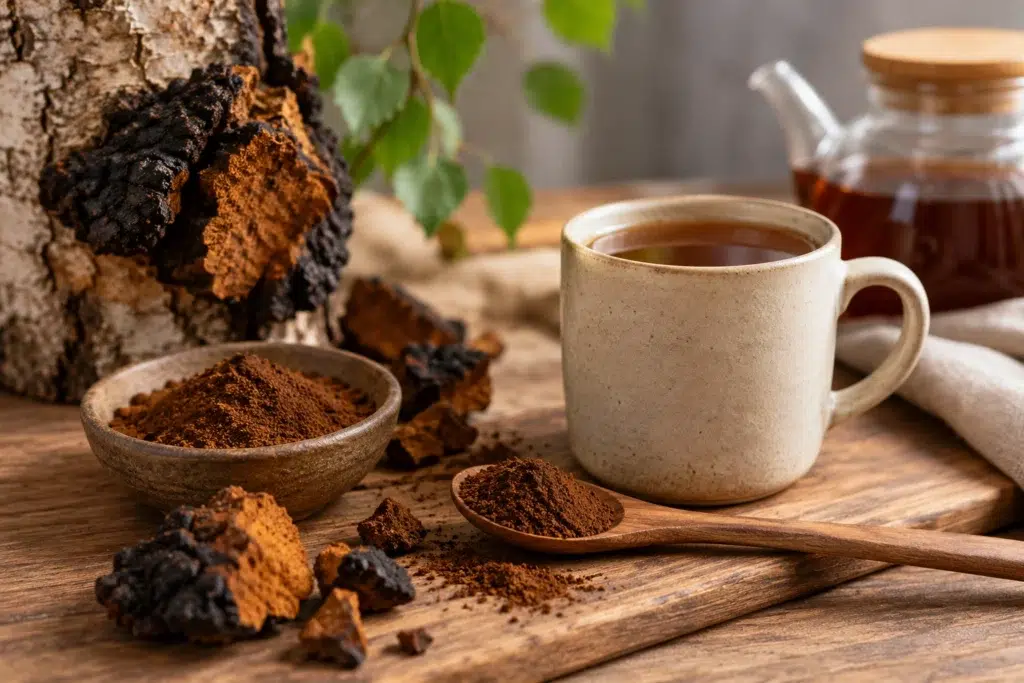
Chaga does not look like a typical mushroom. There is no cap or stem. Instead, it forms a hard, irregular mass that breaks out through the bark of the tree. The outside is black and deeply cracked, often compared to burnt charcoal. Break it open and the inside is a rusty orange-brown with a cork-like texture.
Its relationship with birch
Chaga is a parasitic fungus. It enters a birch tree through a wound in the bark and slowly grows inside the trunk over many years. The visible black growth can take a decade or more to reach a size worth harvesting. Because it draws on the tree as it grows, wild Chaga collected from birch contains compounds that originate in the birch itself, such as betulin. Researchers have noted that these tree-specific compounds are found in Chaga taken from birch trunks rather than in Chaga grown in other ways.
Which part is harvested
The part collected and used is the black growth on the bark, known as the sclerotium. It is a dense mass of fungal tissue rather than the classic spore-producing fruiting body of most mushrooms. In product descriptions, including ours, the sclerotium is often described as the fruiting body because it is the part of the fungus that is traditionally harvested. Siam Vital Chaga Mushroom Powder is made only from this material, with no mycelium grown on grain and no added fillers.
Traditional use of Chaga
Chaga has a long history in the folk traditions of Siberia, Northern Europe and northern China. In these regions, it was typically broken into pieces, simmered in water for a long time and drunk as a dark tea. In parts of Northern Europe, it was also used as a substitute for coffee or black tea when those were hard to come by.
Because Chaga grows only on birch in harsh northern climates and takes many years to form, it came to be associated with endurance, longevity and resilience. It also appears in literature. Aleksandr Solzhenitsyn mentioned Chaga in his novel Cancer Ward, which helped bring it to wider attention.
These cultural associations are part of Chaga’s story and help explain its appeal. They are not evidence that Chaga has any particular effect on health. Traditional use tells us how people valued a plant or fungus, not what it can be proven to do.
Chaga powder vs Chaga extract
Chaga is sold in two main forms. Powder is the whole dried sclerotium, cleaned and finely ground. It contains everything in the original material, including its fibre, and is closest to the traditional practice of using the whole fungus. Extracts are made by soaking Chaga in hot water, alcohol or both, then concentrating the result. They contain a higher proportion of certain compounds per gram but lose some of the original material in the process.
Neither format is universally better. Powder suits people who prefer a minimally processed, whole-food product. Extracts suit people who want a smaller daily amount. One practical difference with Chaga: because it is so hard and dense, a fine grind matters for how well the powder mixes into liquid.
Natural compounds in Chaga and what research is looking at
Chaga contains a wide range of naturally occurring compounds. The ones most often studied include:
- Polysaccharides, including beta-glucans, which are common to many mushrooms.
- Triterpenoids, such as inotodiol, trametenolic acid, betulin and betulinic acid. Betulin and betulinic acid are linked to Chaga’s birch host.
- Polyphenols, a broad group of plant and fungal compounds.
- A melanin complex, which gives the outer layer its deep black colour.
A 2023 review in Mycology summarises research into these compounds across areas such as antioxidant activity, inflammation, immune function and blood sugar regulation. It is important to understand what kind of research this is. The great majority comes from cell cultures in the laboratory and from animal studies. An earlier review titled “from folk medicine to clinical use” concluded that human studies meeting evidence-based medicine criteria are still needed, and Memorial Sloan Kettering Cancer Center notes that Chaga’s safety and efficacy have yet to be evaluated in clinical studies.
A result in a cell culture or a mouse does not show that the same thing happens in a person drinking a cup of Chaga tea. Doses, preparations and the way the body absorbs compounds can all differ. For now, the honest picture is that Chaga is an interesting subject for research, but it should not be bought with any particular health outcome in mind.
How to use Chaga mushroom powder
Flavour
Chaga powder has a dark, earthy character with a mild bitterness. Many people compare it to strong black tea or a coffee alternative. The bitterness softens in hot liquid, so Chaga tends to work as a background note rather than a dominant flavour.
Suitable preparations
Chaga powder is versatile. Some simple ways to use it:
- As a warm drink. Stir it into hot water or a cup of brewed tea. It pairs especially well with black tea, such as our Handpicked Black Tea.
- With a Himalayan blend. Add it to a cup of Kathmandu Cosmos Tea Blend for a warming combination.
- In smoothies and plant-based drinks. Its earthy note works well with cocoa, banana or oat milk.
- In savoury dishes. Stir it into soups, broths and plant-based recipes.
Serving guidance
The suggested serving for Siam Vital Chaga Mushroom Powder is 1 to 2 teaspoons, about 2 g per teaspoon, as stated on the pack. A 100 g pouch provides around 50 servings.
Two practical tips from our product instructions: mix the powder into liquid that is warm but not boiling for the smoothest result, and stir well, because Chaga settles quickly at the bottom of the cup. If you are new to Chaga, start with 1 teaspoon and see how it suits you before increasing.
Sourcing, processing and testing
Our Chaga is hand-collected from naturally growing birch trees in the northern forest regions of China. After harvesting, the sclerotium is carefully cleaned, gently dried and finely ground. This simple process preserves Chaga’s dark brown colour and natural aroma.
- Ingredients: 100% Chaga (Inonotus obliquus) sclerotium powder.
- What is not included: no mycelium, grain substrate or fillers.
- Format: 100 g in a resealable pouch.
- Testing: every batch is independently lab-tested to confirm compliance with European quality and safety standards.
Wild sourcing comes with a responsibility. Because Chaga grows slowly, Memorial Sloan Kettering notes that natural reserves have come under pressure, and responsible collection matters. Store your powder in a cool, dry place away from sunlight, and reseal the pouch after each use.
What to know before using Chaga
Chaga is not right for everyone, and it has some considerations that are specific to this mushroom.
Oxalates and kidney health
Chaga is unusually high in oxalate, a natural compound also found in foods such as spinach, rhubarb and black tea. In large amounts, oxalate can form crystals in the kidneys. One Korean case report measured 14.2 g of oxalate per 100 g of Chaga powder. If a product contained a similar level, a 2 g teaspoon would provide roughly 280 mg of oxalate. Oxalate levels vary between batches and sources, so this is only an illustration, but it shows why amount matters.
Several published case reports describe kidney injury in people who took Chaga daily for months, often at several teaspoons a day. In one case, the person was also taking vitamin C supplements, which the body can convert into oxalate. If you have kidney disease, a history of kidney stones or a diet already high in oxalate, speak to your doctor before using Chaga. For everyone, it is sensible to keep to the suggested serving, drink enough water and take occasional breaks after long periods of daily use.
Medication precautions
Laboratory and animal research suggests Chaga may affect blood clotting and blood sugar. For this reason, Memorial Sloan Kettering advises talking to a healthcare provider before use if you take blood thinners such as warfarin, and notes possible additive effects with blood sugar-lowering medication. Clinical guidance also commonly suggests stopping Chaga at least two weeks before planned surgery. If you take immunosuppressants or any regular prescription, check with your doctor or pharmacist first.
Pregnancy, breastfeeding and allergies
There is not enough research on Chaga during pregnancy and breastfeeding, so it is best avoided unless your doctor advises otherwise. Anyone with a known allergy to mushrooms or moulds should also avoid it.
Final thoughts
Chaga stands apart from the other mushrooms in our range. It is collected from wild birch trees rather than cultivated, takes years to form, and was traditionally brewed into a dark, warming tea by people living through long northern winters. Its compounds are a genuine subject of scientific interest, but the evidence in people is still limited, so it is best enjoyed for what it is: a mushroom with deep cultural roots and a distinctive, earthy character.
Used in moderate amounts and with attention to the oxalate and medication points above, Chaga can be a calm and steady part of a daily ritual, whether stirred into a morning tea or a winter broth. If you would like to try it, Siam Vital Chaga Mushroom Powder is part of our Immunity & Balance collection.