Gold tea usually refers to Golden Tips black tea made from young tea buds that turn golden during oxidation. Siam Vital’s Golden Tips comes from eastern Nepal and is made exclusively from hand-picked, unopened buds, giving it a smooth, naturally sweet cup with caramel, baked-fruit and light floral notes.
Key Takeaways
- Golden Tips is a true black tea made from Camellia sinensis, not a turmeric drink or tea decorated with edible gold.
- Siam Vital’s Golden Tips is grown in the foothills of Mt. Kanchenjunga in eastern Nepal and harvested in small batches.
- Unlike conventional black tea, it is made only from unopened buds rather than a mixture of buds and mature leaves.
- The buds are hand-picked, withered, rolled, fully oxidised, dried and sorted, with careful processing required at each stage.
- The brewed tea is bright golden amber, medium to full bodied, smooth and low in bitterness, with notes of caramel, baked fruit and subtle florals.
- For brewing, use around 2 g per cup, water at 90–95°C and a 4–5 minute steep; the buds can also be infused a second, or even third time.
- Golden Tips naturally contains caffeine, making it better suited to the morning or early afternoon.
Golden Tips: a Himalayan black tea from eastern Nepal
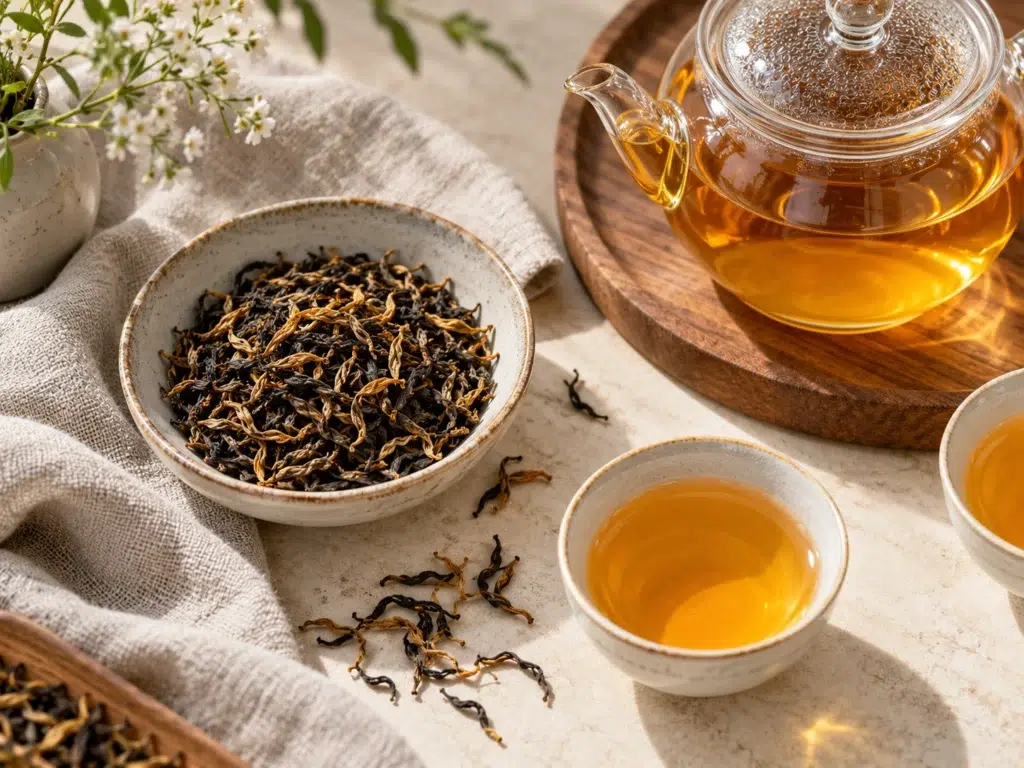
Some teas are made to be drunk quickly. Others ask you to slow down and look at the leaf before you brew it. Golden Tips Black Tea belongs to the second group. Open the pouch and you will find small, twisted buds in shades of copper and gold, very different from the dark, broken leaf of an everyday black tea.
Our Golden Tips is grown in the foothills of Mt. Kanchenjunga in eastern Nepal, where cool mountain air, high elevations and mineral-rich soils shape the character of the tea. Nepal is a young name in fine tea compared with its neighbour Darjeeling. Its first estate was planted in Ilam in 1863, but the country’s specialty tea scene only grew strongly in recent decades, as small gardens and cooperatives began producing high-quality orthodox tea under their own name.
Within the Siam Vital range, Golden Tips sits in the Herbal Heritage collection alongside its white tea counterpart, Silver Tips. Both come from the same region and both are made only from buds. One is processed as a white tea, the other as a black tea, and the difference in the cup is striking.
What is gold tea?
“Gold tea” is a loose term, so it helps to be precise. In specialty tea, it usually means a golden tips black tea: a black tea made largely or entirely from young buds, which turn golden during processing. Several tea regions produce their own versions. China’s Yunnan province is known for Yunnan Gold, and Assam and Darjeeling in India also make tippy black teas.
The term is sometimes used for other things too, such as turmeric drinks sold as “golden tea” or novelty teas decorated with edible gold leaf. Those are unrelated.
What the golden tips actually are
A “tip” is the young, unopened bud at the end of a tea shoot. These buds are covered in fine, downy hairs. In a white tea such as Silver Tips, minimal processing keeps those hairs silvery. In a black tea, the buds go through full oxidation, and the hairs take on a golden colour that stays visible once the tea is dried.
So the gold is not added or dyed. It is the natural colour of oxidised buds. The more buds a black tea contains, the more golden it looks. Our Golden Tips is made exclusively from young, unopened buds rather than a mix of buds and leaves, which is why the dry tea looks almost entirely gold.
How Golden Tips differs from a conventional black tea
Most black teas, including many good loose leaf teas, are made from a combination of buds and mature leaves. A common plucking standard takes the bud plus the next one or two leaves, and much of the world’s black tea is cut and torn by machine into small pieces to brew quickly and strongly. Golden Tips differs at almost every stage:
- Plucking standard. Only the unopened bud is picked, not the bud with its leaves.
- Leaf selection. Mature leaves, which give a black tea much of its strength and astringency, are intentionally left out.
- Processing. Buds are smaller and more delicate than leaves, so withering, rolling and oxidation must be handled with more care.
- Appearance. The dry tea is golden and copper rather than dark brown or black.
- Flavour. The cup is smoother and rounder, with natural sweetness and very little bitterness.
The craftsmanship behind Golden Tips
Every stage of making Golden Tips depends on judgement rather than speed. Here is what happens between the garden and the pouch.
Hand harvesting
The buds are picked by hand in small batches. Pickers select only young, unopened buds, which means moving slowly along the bushes and leaving most of the shoot behind. Far more picking is needed to gather the same amount of tea when compared to a standard leaf-and-bud harvest.
Withering
Freshly picked buds are spread out to lose moisture and soften. Withering makes them supple enough to roll without breaking and begins the natural changes that later develop into aroma.
Rolling
The softened buds are rolled to gently bruise them and shape them into twisted, wiry forms. Rolling releases the natural juices inside the bud so oxidation can begin evenly. With buds this delicate, too much pressure would crush them and too little would leave the oxidation patchy.
Oxidation
The rolled buds are left to oxidise, which turns them from green to copper and develops the deeper, warmer flavours of a black tea. This is also when the downy hairs take on their golden colour. Oxidation has to be stopped at the right moment, as the balance between depth and softness is decided here.
Drying and sorting
Finally, the buds are dried to stop oxidation and preserve the tea. They are then sorted so that only whole, well-formed buds go into the finished tea.
Why craftsmanship makes Golden Tips a premium tea
A premium tea is not defined by price or packaging. It comes down to how much care and selectivity go into each gram. Golden Tips is premium for a few concrete reasons:
- It uses only part of each harvest. Picking buds alone means less tea per bush and more hours per kilo.
- It leaves little room for error. Because there are no mature leaves to balance the cup, the quality depends heavily on the condition of the buds at harvest and on precise processing at each stage.
- It comes from small batches. Smaller lots allow closer attention, but they also limit how much can be made.
- It reflects its origin. Cool mountain air and high elevations in eastern Nepal give the tea a character that is difficult to reproduce elsewhere.
The aroma and flavour of our Golden Tips
The dry buds smell warm and slightly sweet. Once brewed, Golden Tips produces a bright, golden-amber infusion.
In the cup, expect notes of caramel and baked fruit, lifted by subtle floral aromas. The body is medium to full, so it has the depth of a black tea, but the texture stays smooth. Bitterness is very low and the finish is clean, which is why many people drink it without milk or sugar. A second infusion is lighter and often brings out softer variations of the same notes.
Compared with the delicate, floral cup of Silver Tips, Golden Tips is warmer and rounder. They come from the same region and the same bud-only approach, but oxidation takes them in very different directions.
How to brew Golden Tips correctly
Bud-only teas reward a little care. These are the guidelines from our product instructions:
- Measure the tea. Use 1 teaspoon of Golden Tips (about 2 g) per cup.
- Heat the water. Bring fresh water to the boil, then let it cool for 1 to 2 minutes until it reaches about 90 to 95°C. It should be hot but not actively boiling.
- Steep. Pour the water over the buds and steep for 4 to 5 minutes.
- Infuse again. The buds can be infused a second time. Use water at the same temperature and extend the steeping time slightly. The second cup will usually be lighter.
You can adjust the amount of tea and the steeping time to taste. More tea or a longer steep gives a stronger cup with more caffeine. Store the tea in a cool, dry place away from sunlight, and reseal the pouch tightly after opening to preserve freshness.
Wellbeing and rituals
It is tempting to talk about any tea in terms of what it does for you. With Golden Tips, we prefer to talk about how it feels to make it. Measuring the buds, waiting for the water to cool a little and watching the infusion turn gold are small acts of attention. They create a pause in the day that has value in itself.
Golden Tips contains caffeine, as all black tea does. The exact amount in a cup depends on how much tea you use, the water temperature and the steeping time. That makes it best suited to the morning or early afternoon rather than the evening. If you are sensitive to caffeine, a lighter cup or an earlier time of day may suit you better.
How Golden Tips can become part of a daily ritual
A tea ritual does not need to be elaborate. It needs to be repeatable. A few simple ways to bring Golden Tips into your day:
- A slow start. Brew a cup before checking your phone and drink it while it is still warm.
- A focused work session. Make a pot at the start of a morning block of work, and use the second infusion as a natural break.
- An early afternoon pause. A cup after lunch offers a calmer alternative to another coffee.
- A shared moment. Its smooth, approachable taste makes it a good tea to serve guests who do not usually drink loose leaf tea.
Golden Tips is also the tea in our Morning Focus Ritual, where it is paired with Cordyceps, Lion’s Mane and 10% Full Spectrum CBD Oil for a structured start to the day.
Final thoughts
Gold tea is, at heart, a simple idea: a black tea made from the youngest part of the tea plant, picked by hand and processed with patience. What makes our Golden Tips distinctive is the combination of a bud-only harvest, small-batch craftsmanship and the high gardens of eastern Nepal. The result is a cup that is warm, smooth and quietly complex.
If you enjoy black tea and want to taste what careful selection brings to it, Golden Tips Black Tea is a good place to begin. Brew it slowly and give it your full attention for a few minutes.